REVIEW · OLYMPIA
Katakolon 7hour tour : Olympia-Honey Farm-Winery-Beach
Book on Viator →Operated by DORA TRAVEL KATAKOLON OLYMPIA TOURS · Bookable on Viator
A day at Olympia, minus the cruise-stress. This private Katakolon excursion strings together Ancient Olympia with farm tastings and a beach finale, all built for a 7-hour port stop.
I especially like that you travel in an air-conditioned private vehicle just for your group, with live English commentary on the ride.
The potential drawback: the big archaeological stops run on a tight schedule, and entrance fees plus optional add-ons (like a licensed guide inside the site) are extra.
In This Review
- Key points to know before you go
- Katakolon pickup and the comfort factor
- Olympia in a port-day window: ruins first, museum second
- Stop 1: Archaeological Site of Olympia (self-exploration time)
- Stop 2: Archaeological Museum of Olympia (Classical masterpieces)
- Klio’s Honey Farm: a family-run break with real beekeeping details
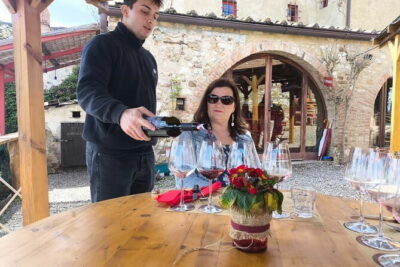
- Magna Grecia tasting: olive oil, olives, and wine without the rush
- Saint Andrew Beach near Katakolon: sand, rocks, and sea views
- Price and value: what $663.75 covers (and what it does not)
- Guides, pacing, and how customization usually works
- Who should book this tour?
- Should you book Katakolon Olympia–Honey Farm–Winery–Beach?
- FAQ
- How long is the Katakolon Olympia–Honey Farm–Winery–Beach tour?
- Is this tour private, and how many people can go?
- Do I need to pay for entrance to the archaeological site and museum?
- Are food and drinks included?
- Is the honey farm admission included or an extra cost?
- Where do we meet at the port?
- What’s the cancellation window?
Key points to know before you go
- Private group touring (up to 15) means less waiting and more flexibility with time.
- Olympia ruins + museum in one stop saves you from the usual logistics headache in a port day.
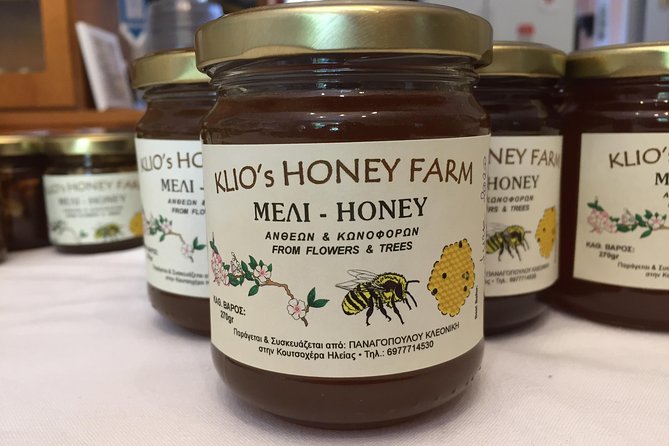
- Klio’s Honey Farm includes a hands-on introduction to beekeeping and a classic honey sweet called diples.
- Magna Grecia tasting focuses on extra-virgin olive oil, olives, and wines from the family’s production.
- Saint Andrew Beach is close to Katakolon port (about 4 km), so your day can end with sea views without feeling rushed.
Katakolon pickup and the comfort factor
This is a port-day tour designed around one key challenge: getting everyone from the ship into the countryside and back with enough time to enjoy it. You meet at John Latsis Katakolo Port, then you’ll follow the directions through the port (exit the port gate, turn right, follow the red footpath, and look for your guide holding a sign with your name).
Once you’re loaded up, you’re not stuck on a big shuttle with strangers. The tour runs in an air-conditioned vehicle sized for your group (up to 15 people), and you get live commentary on board plus bottled water.
A practical bonus: the tour provides a guidebook for Olympia. Even if you do not choose an additional licensed guide inside the ruins, you still arrive with the context you need to spot what matters.
One more detail worth planning for: the itinerary includes admissions that are not included in the base price, so bring a little extra cash/card readiness for museum and site tickets.
You can also read our reviews of more tours and experiences in Olympia.
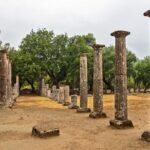
Olympia in a port-day window: ruins first, museum second
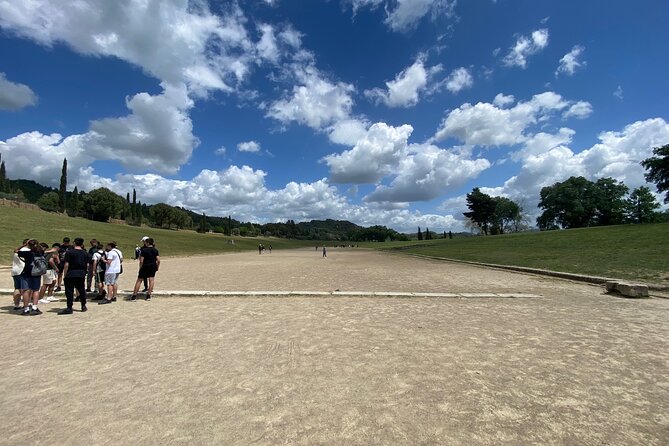
The day’s backbone is Ancient Olympia, where the games were held every four years in honor of Zeus. You’ll start at the archaeological site and then head to the Archaeological Museum of Olympia right after.
Stop 1: Archaeological Site of Olympia (self-exploration time)
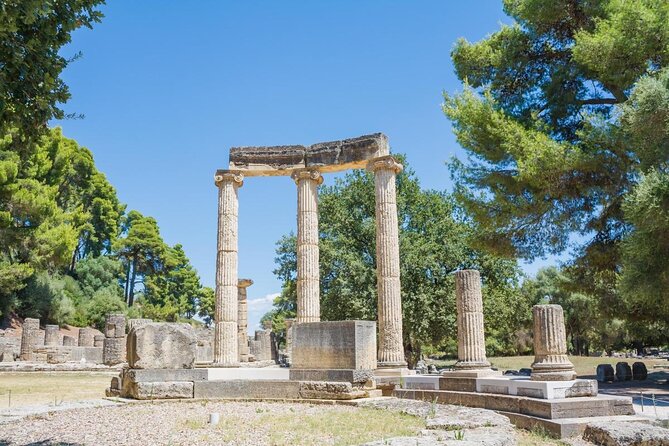
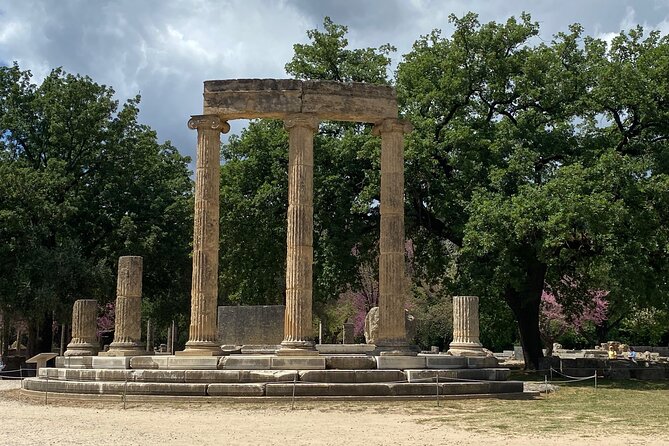
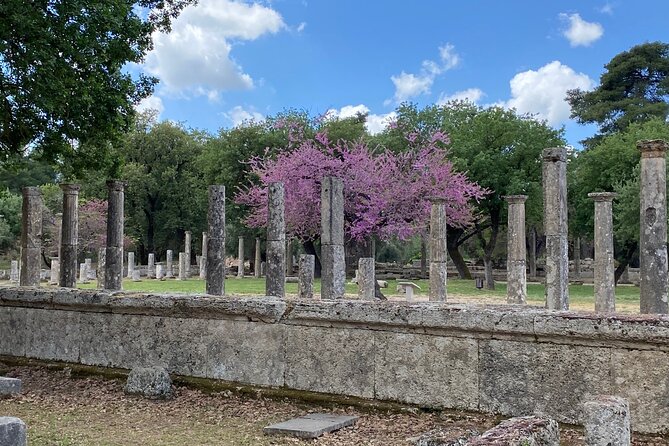
You’ll get about 1 hour at the site, and it’s on you how you spend it. That means it helps to prioritize what you care about most, because there’s a lot here. Highlights you should aim to look for include the Temple of Zeus—associated with one of the ancient Seven Wonders—and the Temple of Hera, where the Olympic torch is lit.
Also note the guide option: the tour does not include a licensed guide inside the archaeological site in the standard price. If you want one, it’s available for an additional fee, and you’re advised to contact ahead of time.
What this means for your day: if you love history but also want to move at a calm pace, you might choose the optional licensed guide for extra clarity. If you’re more into photos and big-picture understanding, the self-guided time still works well—just don’t try to see everything.
Stop 2: Archaeological Museum of Olympia (Classical masterpieces)
The museum stop is also about 1 hour. This is where the site’s stories become easier to understand because you’re seeing famous works from the Classical Period.
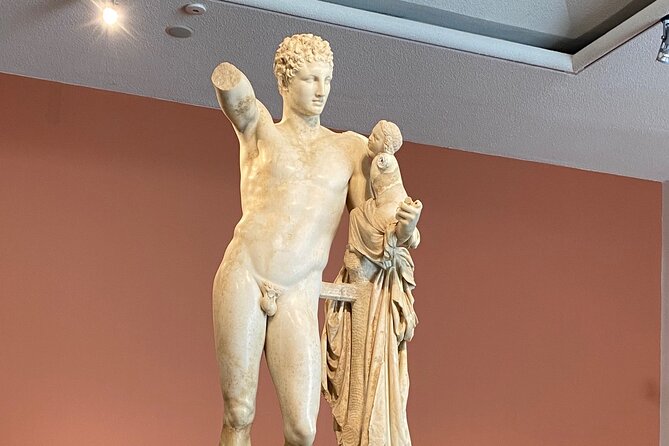
Look for the pediments from the Temple of Zeus, plus sculptures including Nike of Paionios and Hermes of Praxiteles. Even if you are not a sculpture expert, these names matter because they’re tied to what you saw at the ruins.
Practical tip: if you’re trying to beat the crowds and keep energy up, a museum after the site is a smart rhythm. The ruins get you the scale; the museum gives you detail.
Klio’s Honey Farm: a family-run break with real beekeeping details
After Olympia, you’re close to where the day turns from stone to something sweeter—Klio’s Honey Farm. The timing here is smart: it’s a “reset” stop before your tastings and beach time.
You’ll spend about 1 hour at the farm. Admission is listed as free, and the experience includes a welcome spread with seasonal fruits, fresh juice, and coffee. Then you get a guided presentation with beekeeping tools and an explanation of how bees fit into life from ancient times to today.
One of the reasons people love this stop is that it feels local rather than performative. You’re meeting Klio and her mother at their farm, in a garden setting with fruit trees and vegetables.
You’ll also finish with diples, a traditional honey sweet. It’s not just a snack; it’s the kind of food detail that makes a Greek countryside stop memorable because you can taste the theme right away.
Cost note to double-check: one part of the tour details lists the honey farm as an add-on price (12€ per adult and 9€ per child), while the stop description also says honey farm admission is free. Before you go, confirm what applies to your booking so you’re not surprised.
Magna Grecia tasting: olive oil, olives, and wine without the rush
The next cultural-food stop is Agriturismo Magna Grecia. This is a family operation created in 2009 by Dimitri Karabelas and Franca Magrini. Here, the focus is extra-virgin olive oil, olives, and wines they produce.
This is a stop built around tasting. The tasting is listed as an additional cost (20€ per person), so the base tour price covers your transportation and the overall visit flow, but the actual tasting experience has a fee.
What I like about this stop for a port day: it matches what Olympia and the museum give you intellectually with something you can understand through taste and product. You’re seeing how the region feeds itself now, not just what it valued long ago.
If your group has non-drinkers, this stop can still be worth it because olive oil and olives are part of the experience. In practice, the day often gets adjusted to the group’s interests, and that flexibility is a big reason this tour earns so many strong marks.
Saint Andrew Beach near Katakolon: sand, rocks, and sea views
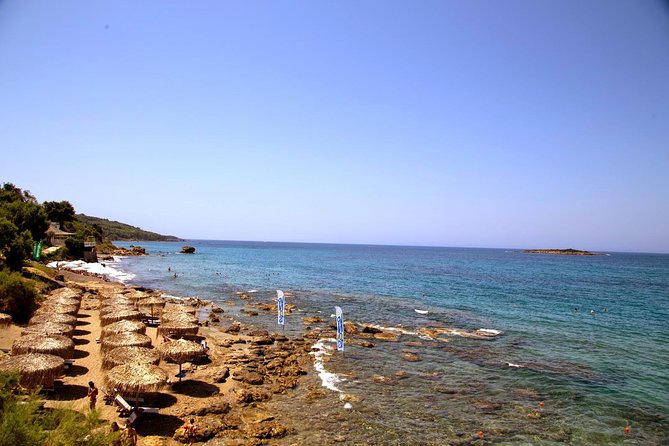
The finale is Saint Andrew Beach, located close to the Katakolon port—behind the hill of Katakolon, about 4 km away. The beach is described as having thick sand and rocks in summer, and it offers a magnificent view of the sea.
It also has a cafe and a traditional restaurant, which matters because it turns the beach from a quick stop into a real option to slow down. You can grab coffee or a meal and let the day cool off naturally.
One consideration: depending on the weather, the water can feel chilly. The beach is great for views and toe-dipping, but if you’re traveling with swimmers, keep your expectations flexible and aim for fun rather than perfection.
In short, this ending works. You get fresh air after museums and tastings, and you’re close enough to the port that getting back is not a big scary mystery.
Price and value: what $663.75 covers (and what it does not)
The tour is priced at $663.75 per group for up to 15 people, and it runs for about 7 hours. On paper, that can sound steep until you break down what you’re buying.
Here’s the value logic I see:
- You’re not paying per person for the vehicle. You’re paying for a private, air-conditioned ride plus live English commentary and port pickup/drop-off.
- You’re also getting structured time at Olympia (site + museum), plus two farm/food experiences and a beach finish.
- Your group gets bottled water and an Olympia guidebook, and those small included items add up when you’re on a cruise schedule.
Now the costs that are not included:
- Archaeological site and museum entrance: listed as 20€ per person
- Magna Grecia tasting: listed as 20€ per person
- Food/drinks: not included overall (though you do get fruits/juice/coffee at the honey farm)
- Honey farm pricing: again, double-check because one note lists a honey farm add-on price while the honey farm stop description also says admission is free
My suggestion for budgeting: plan for the base tour price plus archaeological admissions and the Magna Grecia tasting if you want to do the full product experience.
If you split the base cost among a group, this becomes much easier to swallow, especially when you compare it to per-person cruise excursions that often group you with a bunch of strangers.
Guides, pacing, and how customization usually works
This tour’s success often comes down to the guide. Names that come up include Dora, Joanna, Fotis, and Konstantina (Tina), plus licensed-site accompaniment from people like Zoey and Aristea when that optional layer is chosen.
The good part for you: these guides tend to take your group’s energy seriously. That matters if you have kids, older adults, or mobility needs. One group even described bringing a non-motorized wheelchair and fitting it into a Mercedes van, with flexibility built around the day.
You should also know what the itinerary format implies: Olympia is scheduled fairly tightly. About 1 hour at the ruins and 1 hour at the museum can feel fast if your group wants to read slowly and take lots of photos. If your group is the type that likes to stop and absorb, consider adding the optional licensed guide at the archaeological site so you’re not just walking through puzzle pieces.
Who should book this tour?
I’d point you toward this tour if:
- You want Olympia in one port day without fiddling with transport.
- You like a mix of ancient sites + local food product (honey, olive oil, olives, and wine).
- You’re traveling with family and want a private group setup that can adapt.
- You value clear English commentary while you move between stops.
I’d think twice if:
- You already feel confident at Olympia and want a longer, slower ruins deep dive without extra costs.
- Your group hates add-on fees for entrances and tastings.
- You’re hoping everything is included. Here, major items like museum and site entry have an extra bill.
Should you book Katakolon Olympia–Honey Farm–Winery–Beach?
Book it if you want an efficient, genuinely local-feeling port day: Olympia ruins + the museum for context, Klio’s Honey Farm for hands-on culture and sweets, Magna Grecia for olive oil and wine tasting, then Saint Andrew Beach to land the day with sea views.
Skip or modify if you need more time at the ruins than the schedule allows, or if you want licensed guiding inside the site included in the base price. In that case, budget for the add-ons and, if possible, plan for a licensed guide upgrade so your time on the ground matches what you want to learn.
If you’re booking soon: this kind of combo tour is popular for cruise stop timing, so it’s smart to reserve early and confirm any add-on pricing questions (especially around the honey farm).
FAQ
How long is the Katakolon Olympia–Honey Farm–Winery–Beach tour?
It runs for about 7 hours.
Is this tour private, and how many people can go?
Yes. It’s private, and it’s listed as up to 15 people per group.
Do I need to pay for entrance to the archaeological site and museum?
Yes. The Archaeological site and museum entrance fee is listed as 20€ per person, and admission tickets are noted as not included.
Are food and drinks included?
Food and drinks are listed as not included overall. The honey farm stop includes a welcome platter with fruits, juice, and coffee as part of the farm experience.
Is the honey farm admission included or an extra cost?
The honey farm stop description lists admission ticket free, but the pricing section also lists honey farm as an add-on (12€ per adult and 9€ per child). Confirm what applies to your booking before you go.
Where do we meet at the port?
Meet at John Latsis Katakolo Port. After you exit the port gate, turn right and follow the red footpath; the guide waits at the end of the red lane holding a sign with your name on it.
What’s the cancellation window?
You can cancel for a full refund up to 24 hours before the experience start time.